Showing posts with label skills. Show all posts

Monday, 20 March 2017

Career tool: Individual development plan

I just discovered this excellent individual development plan (IDP) that helps you explore career possibilities and set goals to follow the career path that fits you best. The American Association for the Advancement of Science has an online tool for PhD and postdoctoral researchers in the sciences, and provides:    
  • Exercises to help you examine your skills, interests, and values
  • A list of 20 scientific career paths with a prediction of which ones best fit your skills and interests
  • A tool for setting strategic goals for the coming year, with optional reminders to keep you on track
  • Articles and resources to guide you through the process
Help for career planning is all too scarce, so it is well worth the effort of completing the assessment of your skills, interests and values, At the end, all of the inputs (assessments of skills, interests and values, as well as skill goals, project goals, mentors etc.) are collated in a customized individual development plan that you can share with a mentor or supervisor.

https://myidp.sciencecareers.org/

Thursday, 6 February 2014

And our next speaker is….


https://www.youtube.com/watch?v=cXJJvvjSB9c
Fergus McAuliffe in action at a packed TEDxDublin
- read on to find out how he prepares for presentations...
The hot seat. You’re in it. About to stand up and present your work in front of 100 members of the public. People who you don’t know you at all. People who know even less about what you research. Your palms are sweaty, knees weak, arms are heavy. Rapping in Detroit it seems, is just like presenting to the public. You shift in your seat.

We’ve all been in a similar presenting scenario to this at some point. But it doesn’t have to be like this.
To help, below are five tips. Not quite learned on the streets of Detroit, but useful nonetheless.


Tuesday, 27 August 2013

Ten tips for (novice) conference presenters


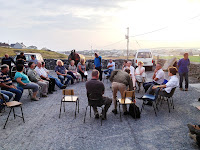
A presentation to a farmer group on the Aran Islands on a wonderful summer's evening.
Not all presentations require slides!
Having recently attended a number of major international conference, I’ve seen a lot of good and not so good practices. If you are a novice presenter and willing to learn, here are a few pieces of advice, and some relevant further reading...


1.  Know your main message. Communicate your main message, and repeat it for emphasis. Ensure that the audience receives your main message. Again, the the most important point here is that your presentation (and you) actually has a main message – I’ve attended a few talks in which I don’t think the speaker knew their own main message (and neither did I). A good sign that you don’t have a main message is when you have three finishing slides called Conclusions 1, Conclusions 2 and Conclusions 3! And why not finish with a tweetable 140 character summary of your work? (latter two points from @entoprof)

2.  Familiarise yourself with your environment. This includes the room, the pointer, the screen, the lighting etc. Check that fonts, formatting and any animations are compatible with the local software/hardware – long before your talk begins. Larger conferences often have a dedicated room where you can upload and check this. Even if there is not a dedicated room, use the time during the coffee or lunch breaks to familiarise yourself with the room and the equipment. Have a glass of water poured and nearby the lectern (and away from electronics!).

3.  Introduce yourself to the session chairman well in advance of the session. Don’t leave them guessing until the last moment about whether or not you are attending, whether you are in the room, or whether you’ve uploaded your presentation.

4.  Include your Twitter handle/blog address, and keep it apparent on a few consecutive slides where people can get enough time to record/type it.

5.  This is especially for novice presenters: spend less time on your background and methods, and more time on your results and why they are important/influential. This is extremely important when the amount of time spent on methods starts threatening the time that’s available to present the results – this happens far too often. Looking at experienced presenters at plenary talks, they spend the minimum of time on methods, and most of their time on results and the impact of their results.

6.  Take time to explain your main points/results/figures/graphs. You may be familiar with them, but the audience is not.
Rehearse your talk in front of people who have not seen your talk before, and ask them questions about your main points/results/figures/graphs. You'll very quickly discover that they will not quite understand you in the way that you expect! This can happen to the best of presenters – which is why the best of presenters always spend a lot of time preparing.
You should never have to begin your explanation of a slide with an apology- this is a sign that something is wrong, which is also sign that something needs to be fixed. The most common apologies are: “I know there is too much text on this slide but…”, “I know that there is a lot going on in this table, but…”, and “It’s not so clear here, but…”.

7.  Don't run out of time at the expense of your most important messages. As a presenter, this is a wasted opportunity for your work and you to make on impression on the audience. As an audience, it is a waste of our time.
If time is tight, then make sure you prioritise your most important points, and that they appear well before, for example, the 10-minute mark of a 12-minute presentation. If you do run out of time, be very clear (beforehand) about which slides you will sacrifice toward the end, without compromising your main message.

8.  Leave time for questions -questions from the audience are your most important reward for presenting. Questions and comments from your audience represent a wonderful opportunity to receive feedback from other experts.

9.  Don't interrupt someone who is asking a question. This is surprisingly common. The longer you let the questioner talk, the more likely they are to further develop, explain and even paraphrase their question. This helps you to understand their question, and gives you more time to consider a response. Let the person finish their question in its entirety before you say anything- and then give yourself a few seconds of silence to think. If it helps your answer, then go to the slide that addresses the question – not everyone will remember it, and it will almost certainly assist your answer. In addition, you should be able to anticipate some questions, so why not have a few additional slides that you don’t present in the main talk, but that you can refer to if needed?

10.  Make sure that your last slide contains your main conclusions (which should reflect your main message – see point 1). While the chairman intervenes to ask the audience for questions, your main points will remain up on the screen and be reinforced, as well as being a good prompt for questions from the audience. This is far better than leaving the acknowledgements slide on-screen. You can provide acknowledgements somewhere else in your presentation. Lately, I provide acknowledgements as my second slide (after the title), and get them out of the way as part of some introductory comments.


PhD Skill: Conference presentations are a wonderful opportunity to impress others with your work and your skills. Prepare and practice, and make the most of the 15 or 20 minutes when you are centre stage. 


Further online reading
How to Be a Successful Speaker at a Conference: Advice from the Experts (blog post from Search Engine Journal). This is a great resource with three tips from each of several different experienced presenters. A must-read!

DonnaM. 10 tips for conference presentations. A great blog post. 

Sharon Goldwater. Advice on designing and giving presentations (Especially conference presentations). Also includes some other useful links and some specific examples.

Get a life, PhD (blog). How to Give a Fabulous Academic Presentation: Five Tips to Follow

UPDATE: Next Scientist. How to improve the Presentation Skills of PhD Students. Comprehensive treatment by Susanne Ulm - well worth a read, and very engaging.


Thursday, 25 July 2013

Ten tips for the first 100 days of a PhD

To date, we have focused more on issues that affect students in the later stages of their PhD. Here, we make ten suggestions on key activities for PhD students during their first 100 days.

1. Agree/develop a modus operandi with your supervisor(s) (e.g. agree where and how often you expect to meet, how to assess progress when the supervisor is away, the different types of feedback expected etc.).  In some universities, there may be a form to facilitate this (e.g. a learning plan or candidature plan). The following questionnaire may help you to investigate (and discuss with your supervisor) your underlying beliefs (and supervisors) about the student-supervisor relationship: Expectations in supervision questionnaire.

2. Take responsibility for arranging meetings with your supervisor, and provide an agenda in advance of the meeting, ideally with a few short explanatory notes about each topic. This will help your supervisor to understand the issue, and give them more time, subconsciously at least, to spend more time thinking about your agenda items. Make written notes (minutes) of the plans that are agreed with your supervisor.  Even a quick email to your supervisor can be very helpful to enquire ‘this is what I think we agreed, am I on the right track?’  Thinkwell provides a Thesis Meeting Template that should help you structure the main outputs to be achieved from meetings.

3. Write a project plan listing some key initial research objectives and preliminary deadlines (at least). This is easier said than done! This can then become the basis for more detailed planning. See Chapter 3 of Getting a PhD, which addresses project management for PhD students, and there is a multitude of project management resources available online. Remember that a key feature of the assessment of the PhD degree is based on the quality of work - see our earlier post and resources therein for more on this. For planning within shorter timescales, here is a template for a weekly planner.

4. Produce a Gantt chart based on the above for your project activities for the first, say, 6 months. This is a tangible output from your planning, and can serve as the basis for useful discussion with your supervisor.

5. Read journal articles, take notes and write a short literature review (even a few thousand words). You will learn a lot more by writing about what you read than by reading alone, and there is a huge satisfaction in feeling you have a folder on your computer labelled ‘my thesis’ with something in it.  This also makes sure you practice academic writing - a key skill- from your first day.

6. Get feedback from your supervisor(s) on this literature review; on your writing style and how to improve it where necessary; on whether you have read the right articles and; whether you are understanding the knowledge and uncertainties associated with your topic.

7. Read recent PhD theses in your topic to see what is ultimately expected of you. It is amazing how many PhD students do not do this, or leave it until they are almost finished their thesis!

8. Learn and practice new methods that you will need to use - before you start your research. Ensure that you can implement methods correctly - there is no point in progressing with methods and work if you cannot rely on the outputs and results.

9. Develop good professional habits for keeping all your information and data safe and organised (hard copies, papers, data, electronic files etc.). Think about everything that could go wrong (fires, floods, computer viruses) and make sure that data loss will never happen to you.  Increasingly, funding agencies require researchers to protect and archive their data in a secure manner. Check what storage facilities or formal requirements for data storage is available in your lab or institution.

10. Formally or informally review your skills (probably with your supervisor) and do a self-assessment of your training needs. This should help you to work out what skills you need to develop and what opportunities are available to develop these. Then, make a plan to participate in any relevant training events as soon as possible, and before you get really busy. In a previous post, we highlighted resources that should be essential reading, and another post discussed various forms of training.

Of course, there will be many other activities that you should be doing, and different people will have different priorities. Please let us know what other issues or resources that you think are priorities for settling in during the first 100 days!

PhDSkill: Actively manage the early stages of your PhD. The time in your first three months of your PhD is as precious as the last three months - use it as productively as possible!
 
John Finn and Alan Kelly


Useful resources 
John Finn. 2005. Getting a PhD: an action plan to help manage your research, your project and your supervisor. Routledge. (Contains lots of advice on starting a PhD, and develops many of the above points in more detail.)

Bench 21. Starting well: how to do a good first year in your PhD. (Blog post)

Introduction to resources by Thinkwell: Seven Secrets of Succesful Students
photo credit: emdot via photopin cc

Thursday, 4 April 2013

Telling others about your research – no, not experts, real people!


Think like a wise man, but communicate in the language of the people’.
W.B. Yeats

Yes, but was he talking about PhD students??

The core of any PhD is of course the generation of new knowledge, but research is not complete until this knowledge is passed on.  What would be the point of doing the most important and significant research in the world if you were not to tell anyone what was found, or were to tell the wrong people, for whom it would not have an impact, or tell people in such a way that they do not understand the message and its significance?


Friday, 8 February 2013

Seven secrets of successful students - report on training event

This post is a short report on a training event at which postgraduate research students and research supervisors at Teagasc attended a training day provided by Dr Hugh Kearns of Flinders University, Australia.  Hugh is an expert on procrastination (!), an internationally renowned speaker for his motivational seminars, and an accomplished educational researcher.

Here, I want to give an overview of some of the main messages from the day, and also provide further links to some of the resources that Hugh referred to. I aim to have a follow up post with some examples of practical lessons that I took from the event.

Hugh's consultancy provides a number of resources for PhD students and supervisors, and are well worth exploring.

The training focused on 'The Seven Secrets of Highly Successful Students'. A central focus of the day was the supervisory relationship, and the importance for students to write early and often. Whilst students and supervisors are often told this, there was a lot of practical advice on how to better ensure that this aspiration is realised. The table of contents of the accompanying book outlines the seven secrets:

  • Care and maintenance of your supervisor
  • Write and show as you go: This is show and tell not hide and seek
  • Be realistic: It's not a Nobel Prize
  • Say no to distractions: Even the fun ones and the ones you think you must do
  • It's a job: That means working nine to five but you get holidays
  • Get help: You are not an owner-operator single person business
  • You can do it: A PhD is 90% persistence and 10% intelligence

Hugh's presentation is peppered with evidence-based analysis, relevant anecdotes and large doses of practical actions for both students and supervisors.
In the session for supervisors, the following questionnaire generated quite a deal of interest as a means of investigating the underlying beliefs of supervisors and students about the student-supervisor relationship:
Expectations in supervision questionnaire


Selected publications by Hugh Kearns
Gardiner, M. & Kearns, H. (2012). The ABCDE of Writing: Coaching high-quality high-quantity writing. International Coaching Psychology Review, 237-249.

Kearns, H. & Gardiner, M.L. (2011). Waiting for the motivation fairy. Nature, 472, 127.

Gardiner, M. & Kearns, H. (2011). Turbocharge your writing today. Nature, 475, 129.

Kearns, H. & Gardiner, M.L., (2011). The care and maintenance of your adviser. Nature, 469(7331), 570-570.


PhD Skill: learn how to improve your quantity and quality of writing and eliminate procrastination.

Wednesday, 6 February 2013

Training comes in many guises

Training helps to realise your potential.

The award of a PhD degree recognises your successful training to be an independent researcher. 
Therefore, it's not surprising that PhD research involves a lot of training and learning! Some of the usual training needs include project management, time management, statistics, research methods, reference management software, oral presentations, poster presentations, career development and many others. 

So when was the last time you had some training?

Unfortunately, some PhD students do not receive as many training courses as they expect. However, we often have more opportunities for training than we think. Training is not just something that happens when someone from somewhere else turns up and gives a course. 

A lot of training happens without courses. A few examples should make it clear how training and learning occur in many different forms: 
- attendance at departmental seminars
- discussions with your supervisor about research methods, ethics, publication practices etc.
- reading books about a specific topic
- learning by doing (even if it means making mistakes at first)
- receiving instruction on equipment or methods from a technician
- reading online material about a specific topic (this is how I first learned to create a blog)
- discussions with other researchers about your work or related research
- journal clubs
- receiving advice from other students about software packages
- presenting your work as a poster or seminar, and receiving feedback.

This variety of forms of training doesn't mean that courses are not important. But if you can't get to as many courses as you would like, there's still plenty of training that's available. 

PhD Skill: identify your training needs, some of which may require courses. Be aware of the training that you are receiving, in all its forms, and how it contributes to your professional development.  

photo credit: kevinpoh via photopin cc