Showing posts with label communication. Show all posts

Thursday, 30 August 2018

The art of supervisor wrangling


The art of supervisor wrangling

A colleague of mine was sitting beside a senior academic at a conference. A young researcher was giving a presentation on the preliminary results from their doctoral research, and the senior academic was really impressed. The topic coincided perfectly with his research interests. Meeting the young researcher over coffee, the senior academic paid his compliments, and enquired who was the young researcher’s PhD supervisor. “You are”, they replied... 
Read on for examples of entry-level, and Hall of Fame levels of supervisor wrangling...
Photo: Jerry Lara, San Antonio Express-News

Thursday, 17 September 2015

Link: Talking to the media: 12 top tips for scientists

This is a link to a great article on media communication for researchers. The twelve tips are given here as a list, and see the original Silicon Republic article by Dr Aoibhinn Ní Shúilleabháin and Dr Shane Bergin for more details.

1. Get your message out there
2. What is the purpose of the interview?
3. What do you want to say?
4. Have an ‘elevator pitch’
5. Minimise jargon
6. Colour the conversation
7. Have a catchphrase
8. Set homework for the interviewer
9. Be yourself
10. Nature abhors a vacuum (of talk)
11. Remember: if it’s not live, it will be edited
12. How clean is your lab?

Thursday, 27 August 2015

14 Graduate student essays on the PhD experience

This is a great book (35 pages) that is a must-read for postgraduate researchers. With personal accounts that are intended to give advice that has been learned the hard way, it is essential reading for less experienced research students.
The topics range from networking, communication, supervisory issues, presenting, publishing and, of course, doing research.

How to survive your PhD

https://www.geo.uni-hamburg.de/dokumente/formulare-studienbuero/doktoranden-handbuch.pdf?utm_content=buffer79f62&utm_medium=social&utm_source=twitter.com&utm_campaign=buffer

Thursday, 20 February 2014

A PhD in one sentence

As part of our Agri-Food Graduate Development Programme (AFGDP), we had a fun session about research communication.
Groups of four PhD researchers wrote a one (or two...) sentence summary of their project, and selected one to go forward to a class competition.
The prize...a box of Ferraro Rocher. The outcome ... as follows:

Thursday, 6 February 2014

And our next speaker is….


https://www.youtube.com/watch?v=cXJJvvjSB9c
Fergus McAuliffe in action at a packed TEDxDublin
- read on to find out how he prepares for presentations...
The hot seat. You’re in it. About to stand up and present your work in front of 100 members of the public. People who you don’t know you at all. People who know even less about what you research. Your palms are sweaty, knees weak, arms are heavy. Rapping in Detroit it seems, is just like presenting to the public. You shift in your seat.

We’ve all been in a similar presenting scenario to this at some point. But it doesn’t have to be like this.
To help, below are five tips. Not quite learned on the streets of Detroit, but useful nonetheless.


Friday, 13 December 2013

Seven secrets of successful students (part 2)

This post is a short reflection following a training event at which postgraduate research students and research supervisors at Teagasc attended a training day provided by Dr Hugh Kearns of Flinders University, Australia. This second post about this event (see the first post) focuses on some of the take-home messages. This report is neither intended to be exhaustive, nor highly original. However, it gives an insight into some (and only some) of the useful discussions that occurred.

Friday, 18 October 2013

Sharing science through story (link to TEDx talk)

Fergus McAuliffe is a regular and popular contributor on 'Scientific Communication' to our Agri-Food Graduate Development Programme (3-day training modules for postgrads and postdocs).

Sharing science through story: Fergus McAuliffe at TEDxDublin

Fergus is a PhD student at University College Cork. See here why he is an award-winning presenter and a presenter on RTE's Science Squad. This presentation is a masterclass in the communication of research, is wonderful, and is only 14 minutes long...


Tuesday, 27 August 2013

Ten tips for (novice) conference presenters


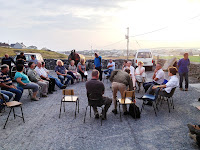
A presentation to a farmer group on the Aran Islands on a wonderful summer's evening.
Not all presentations require slides!
Having recently attended a number of major international conference, I’ve seen a lot of good and not so good practices. If you are a novice presenter and willing to learn, here are a few pieces of advice, and some relevant further reading...


1.  Know your main message. Communicate your main message, and repeat it for emphasis. Ensure that the audience receives your main message. Again, the the most important point here is that your presentation (and you) actually has a main message – I’ve attended a few talks in which I don’t think the speaker knew their own main message (and neither did I). A good sign that you don’t have a main message is when you have three finishing slides called Conclusions 1, Conclusions 2 and Conclusions 3! And why not finish with a tweetable 140 character summary of your work? (latter two points from @entoprof)

2.  Familiarise yourself with your environment. This includes the room, the pointer, the screen, the lighting etc. Check that fonts, formatting and any animations are compatible with the local software/hardware – long before your talk begins. Larger conferences often have a dedicated room where you can upload and check this. Even if there is not a dedicated room, use the time during the coffee or lunch breaks to familiarise yourself with the room and the equipment. Have a glass of water poured and nearby the lectern (and away from electronics!).

3.  Introduce yourself to the session chairman well in advance of the session. Don’t leave them guessing until the last moment about whether or not you are attending, whether you are in the room, or whether you’ve uploaded your presentation.

4.  Include your Twitter handle/blog address, and keep it apparent on a few consecutive slides where people can get enough time to record/type it.

5.  This is especially for novice presenters: spend less time on your background and methods, and more time on your results and why they are important/influential. This is extremely important when the amount of time spent on methods starts threatening the time that’s available to present the results – this happens far too often. Looking at experienced presenters at plenary talks, they spend the minimum of time on methods, and most of their time on results and the impact of their results.

6.  Take time to explain your main points/results/figures/graphs. You may be familiar with them, but the audience is not.
Rehearse your talk in front of people who have not seen your talk before, and ask them questions about your main points/results/figures/graphs. You'll very quickly discover that they will not quite understand you in the way that you expect! This can happen to the best of presenters – which is why the best of presenters always spend a lot of time preparing.
You should never have to begin your explanation of a slide with an apology- this is a sign that something is wrong, which is also sign that something needs to be fixed. The most common apologies are: “I know there is too much text on this slide but…”, “I know that there is a lot going on in this table, but…”, and “It’s not so clear here, but…”.

7.  Don't run out of time at the expense of your most important messages. As a presenter, this is a wasted opportunity for your work and you to make on impression on the audience. As an audience, it is a waste of our time.
If time is tight, then make sure you prioritise your most important points, and that they appear well before, for example, the 10-minute mark of a 12-minute presentation. If you do run out of time, be very clear (beforehand) about which slides you will sacrifice toward the end, without compromising your main message.

8.  Leave time for questions -questions from the audience are your most important reward for presenting. Questions and comments from your audience represent a wonderful opportunity to receive feedback from other experts.

9.  Don't interrupt someone who is asking a question. This is surprisingly common. The longer you let the questioner talk, the more likely they are to further develop, explain and even paraphrase their question. This helps you to understand their question, and gives you more time to consider a response. Let the person finish their question in its entirety before you say anything- and then give yourself a few seconds of silence to think. If it helps your answer, then go to the slide that addresses the question – not everyone will remember it, and it will almost certainly assist your answer. In addition, you should be able to anticipate some questions, so why not have a few additional slides that you don’t present in the main talk, but that you can refer to if needed?

10.  Make sure that your last slide contains your main conclusions (which should reflect your main message – see point 1). While the chairman intervenes to ask the audience for questions, your main points will remain up on the screen and be reinforced, as well as being a good prompt for questions from the audience. This is far better than leaving the acknowledgements slide on-screen. You can provide acknowledgements somewhere else in your presentation. Lately, I provide acknowledgements as my second slide (after the title), and get them out of the way as part of some introductory comments.


PhD Skill: Conference presentations are a wonderful opportunity to impress others with your work and your skills. Prepare and practice, and make the most of the 15 or 20 minutes when you are centre stage. 


Further online reading
How to Be a Successful Speaker at a Conference: Advice from the Experts (blog post from Search Engine Journal). This is a great resource with three tips from each of several different experienced presenters. A must-read!

DonnaM. 10 tips for conference presentations. A great blog post. 

Sharon Goldwater. Advice on designing and giving presentations (Especially conference presentations). Also includes some other useful links and some specific examples.

Get a life, PhD (blog). How to Give a Fabulous Academic Presentation: Five Tips to Follow

UPDATE: Next Scientist. How to improve the Presentation Skills of PhD Students. Comprehensive treatment by Susanne Ulm - well worth a read, and very engaging.


Friday, 10 May 2013

Six reasons why PhD students should make poster presentations


When visiting other institutions, I love learning about people's research  by reading their posters. Here's a picture of the wall outside my own office...
Are research posters a good use of time and effort? I've been intending to write a post about posters since PhDSkills began...so here it is! I've been putting it off because there is so much to talk about, and this will be the first of several posts on posters. Here, I outline six advantages of posters. 

Thursday, 4 April 2013

Telling others about your research – no, not experts, real people!


‘Think like a wise man, but communicate in the language of the people’.
W.B. Yeats

Yes, but was he talking about PhD students??

The core of any PhD is of course the generation of new knowledge, but research is not complete until this knowledge is passed on.  What would be the point of doing the most important and significant research in the world if you were not to tell anyone what was found, or were to tell the wrong people, for whom it would not have an impact, or tell people in such a way that they do not understand the message and its significance?